SG.

HKUST (Guangzhou) / RESEARCH

Songyue Guo

Ph.D. Student · Data Science and Analytics

Learning from data.
Reasoning with evidence.

I am a Ph.D. student at the Hong Kong University of Science and Technology (Guangzhou), supervised by Prof. Lei Chen. My research explores data-centric AI, language-model systems, and evidence-grounded reasoning.

01 / RESEARCH

Questions I work on

Data-centric AI

Data quality, fair data markets, and learning from heterogeneous data.

Language-model systems

Efficient optimization of language-model workflows for data-intensive tasks.

Evidence-grounded reasoning

Retrieval and evidence selection for reliable question answering.

02 / PUBLICATIONS

Selected work

Full list on Scholar ↗

Medical QAMETHOD IN MOTION
Evidence selection: hidden-state features guide evidence-set selection Candidate evidence is analyzed through a frozen LLM’s middle-layer hidden states. Cosine shift, representation drift, coherence and layer gradient inform information-gain scores. A budgeted FPTAS selector chooses complementary evidence for a grounded answer instead of selecting a reranker’s top k. Coverage and document counts are schematic. Beyond a ranked listCandidates carry different kinds of evidence.e1e2e3e4e5e6Reranker → top krank individuallyHidden statesanalyze contributionRETRIEVE → UNDERSTAND CONTRIBUTION Look inside the LLMFrozen LLMCompare H(q) with H(q + evidence).q + eMIDDLE LAYERSIGSCosine shiftRep. driftCoherenceLayer gradientHIDDEN-STATE FEATURES → INFORMATION GAIN Choose a set, not a rankFPTASComplementary evidence · within budgetEVIDENCEEVIDENCE NEEDSe1e2e3e4e5e6ABC2 selectedJOINT UTILITY + TOKEN BUDGET Less evidence.Better answering.[1][2]Grounded answer[1] [2]Hidden states → IGS → FPTAS → Answer
Evidence selection uses hidden-state information-gain features and budgeted FPTAS selection to build a compact, complementary evidence set for medical question answering.
From hidden states to evidence sets

NeurIPS 2026

Less Evidence, Better Answering: Gain-Aware Minimal Evidence Subset Selection for Medical QA

Songyue Guo, Zhao Chen, Caleb Chen Cao, Lei Chen

A compact evidence set selected for joint utility, guided by a frozen LLM’s hidden-state features.
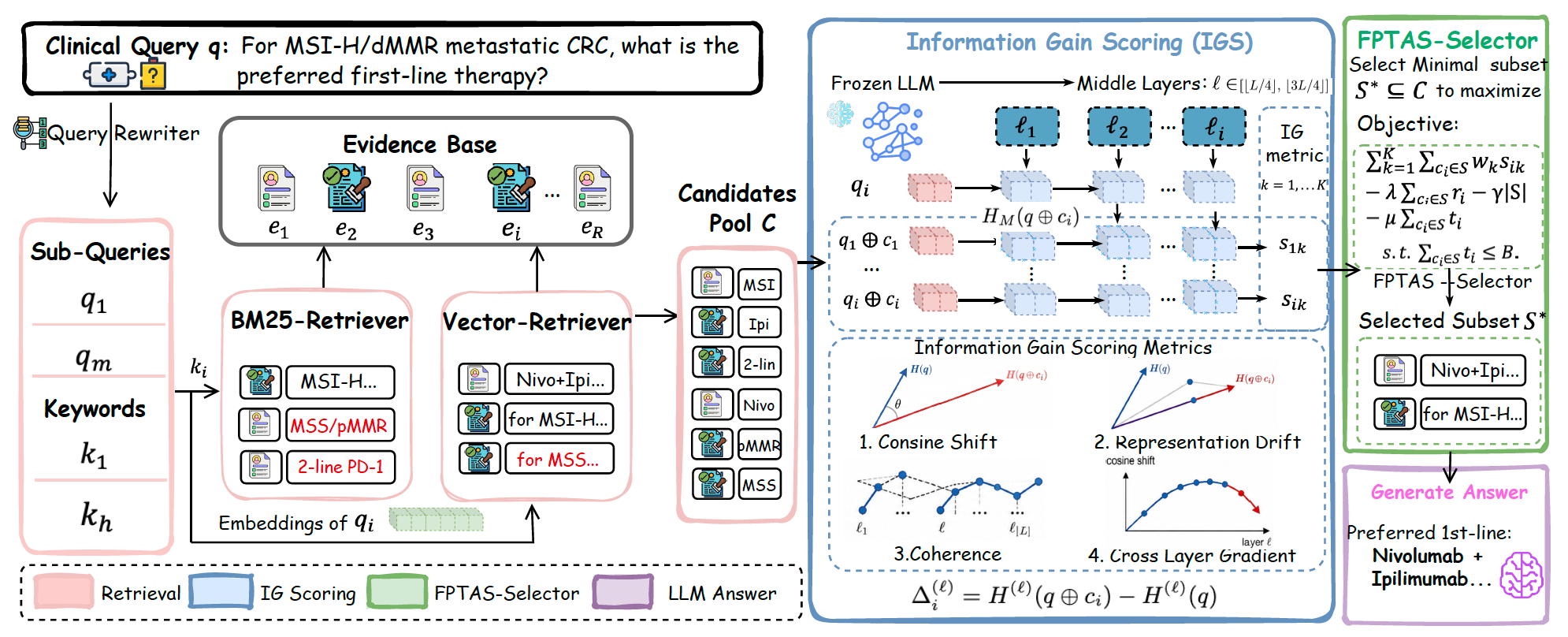
  • Measure information gainCompare query-only and query–evidence representations across the LLM’s middle layers.
  • Select complementary evidenceA budget-aware FPTAS selector builds the subset, beyond an individually ranked top k.
Pipeline: hybrid retrieval, frozen LLM hidden-state feature analysis, information-gain scoring, and FPTAS evidence subset selection before answer generation. Explore the pipeline
FQoraMETHOD IN MOTION
FQora balances seller and buyer utilities through quality-aware pricing Sellers provide data and price anchors. Buyers submit queries with quality requirements and valuations. An arbiter prices the requested data and uses BPO to balance market utilities. Utility bars are illustrative, not measured results or a claim of equal utility. Value on both sides. Quality-aware data. Utility-aware pricing. SELLER Data + price anchors BUYER SELECT data Query + quality ARBITER π BPO Seller utility Buyer utility 01 / MATCH DATA TO THE QUALITY-AWARE QUERY 02 / PRICE THE REQUESTED DATA 03 / BPO BALANCES MARKET UTILITIES SELLER REVENUE ↔ BUYER VALUE
FQora is a quality-aware data market designed to balance seller and buyer utilities with pricing and BPO.
From quality-aware queries to balanced utilities

WWW 2025 · Demo

FQora: Towards Fair and Quality-based Online Data Marketplace

Songyue Guo, Maocheng Li, Zhao Chen, Caleb Chen Cao, Lei Chen

A quality-aware data marketplace designed to balance seller and buyer utilities.
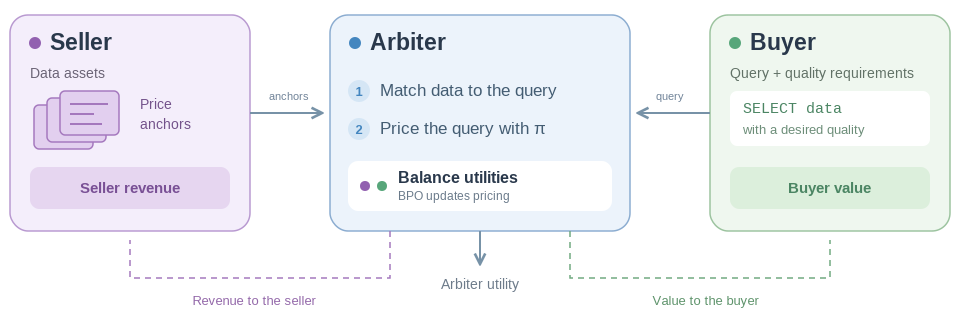
  • Price quality-aware queriesAn arbiter matches data to the buyer’s query and prices it using the seller’s price anchors.
  • Balance both sidesBPO adjusts pricing to balance the utilities of sellers and buyers.
FQora framework: sellers provide data and price anchors; buyers submit quality-aware queries and valuations; an arbiter prices queries and uses BPO to balance market utilities. Explore the market
FedGRFederated learning

DASFAA 2023

Federated Learning with Gravitation Regulation for Double Imbalance Distribution

Songyue Guo, Xu Yang, Jiyuan Feng, Ye Ding, Wei Wang, Yunqing Feng, Qing Liao

Gravitation-based regulation addresses quantity and label imbalance across federated clients.

FedAIMFederated learning

Journal of Computer Research and Development

Federated Adaptive Interaction Model for Mixed Distribution Data

Songyue Guo, Yangqian Wang, Siyuan Bai, Yongheng Liu, Jun Zhou, Mengge Wang, Qing Liao

Adaptive interaction between models trained on differently distributed data.

03 / UPDATES

News & notes

2023.04

Presented FedGR at DASFAA 2023 in Tianjin, China.

2023.03

Released the source code for FedGR.

04 / BACKGROUND

A little more about me

Previously, I studied Computer Science and Technology at Harbin Institute of Technology (Shenzhen), advised by Prof. Qing Liao, and received my bachelor's degree from Shandong University, advised by Prof. Yilong Yin.

Education

Current

Ph.D. · Data Science and Analytics

HKUST (Guangzhou)

Supervisor: Prof. Lei Chen

Graduate studies

Computer Science and Technology

Harbin Institute of Technology (Shenzhen)

Supervisor: Prof. Qing Liao

2016 – 2020

B.Eng. · Software Engineering

Shandong University

Supervisor: Prof. Yilong Yin

Honors & awards

2022

First Class Academic Scholarship

2022

Outstanding Student of HIT (Shenzhen) · Practical Learning Award

2020

Outstanding Graduate of Shandong University

2019

Advanced Individual for Innovation and Entrepreneurship · Shandong University

2018

First Prize in Shandong Province · National Undergraduate Mathematical Contest in Modeling

2018

Special Prize · Qilu College Students Software Design Contest

2017

Meritorious Winner · Mathematical Contest in Modeling

2017

Outstanding Communist Youth League Member · Shandong University

Talks & research experience

Talks

2023.04

Federated Learning with Gravitation Regulation for Double Imbalance Distribution · DASFAA 2023, Tianjin

Research experience

From 2021.05

Computer Application Research Center · Harbin Institute of Technology

2018 – 2020

Towards Intelligence Mechanism Lab · Shandong University

LET'S CONNECT

Good research starts
with a conversation.

sguo349@connect.hkust-gz.edu.cn ↗

Paper method